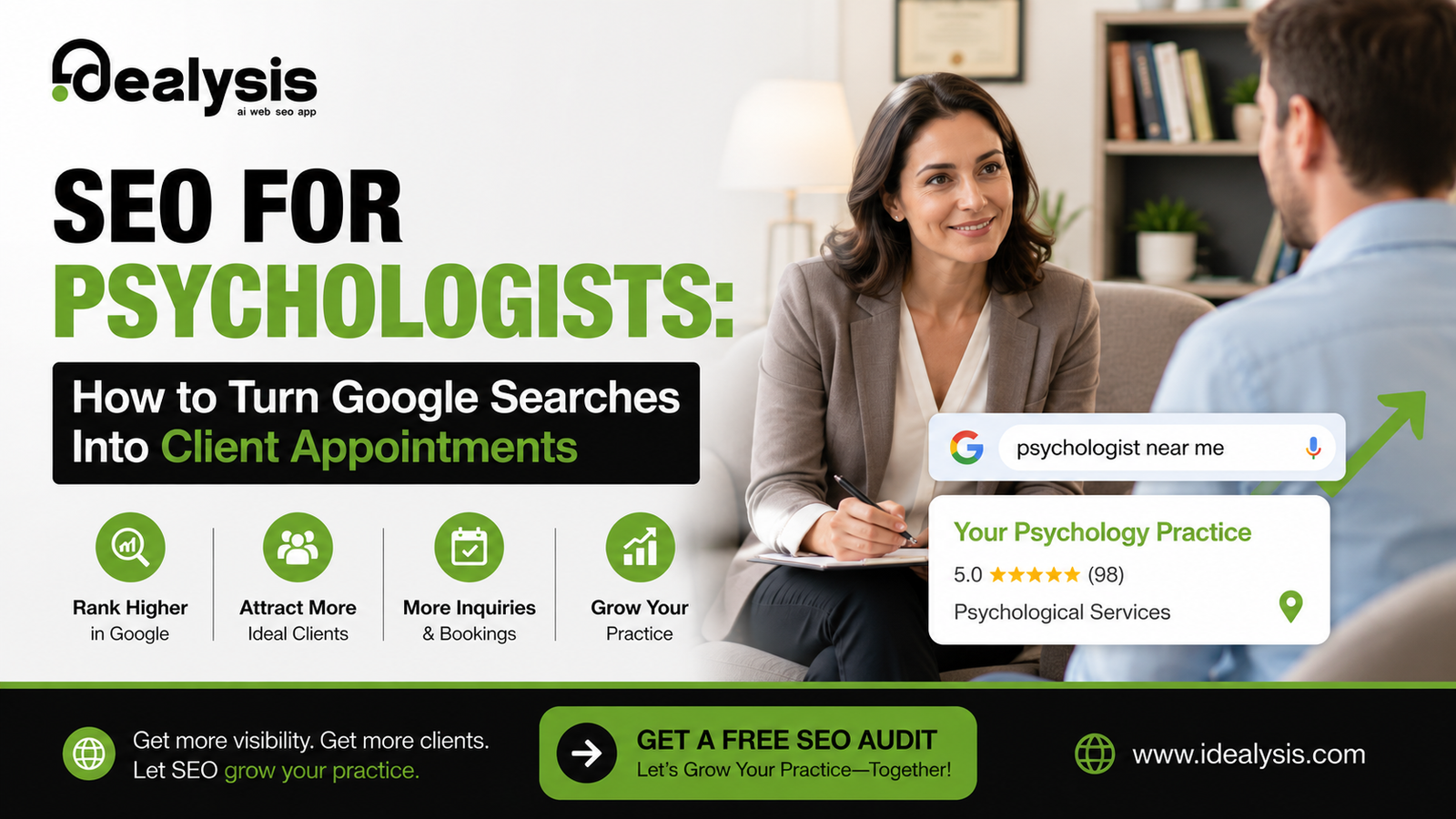
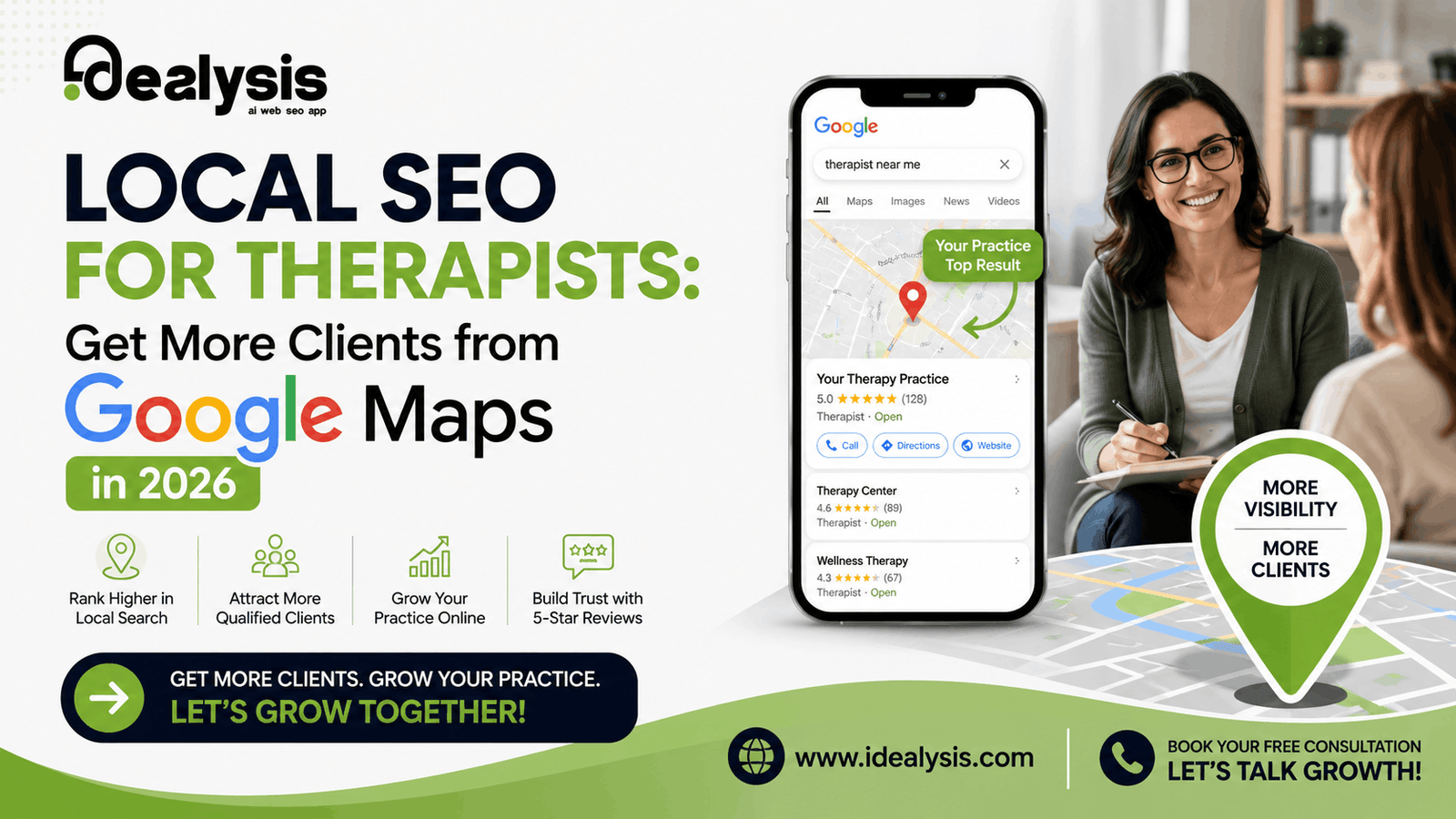
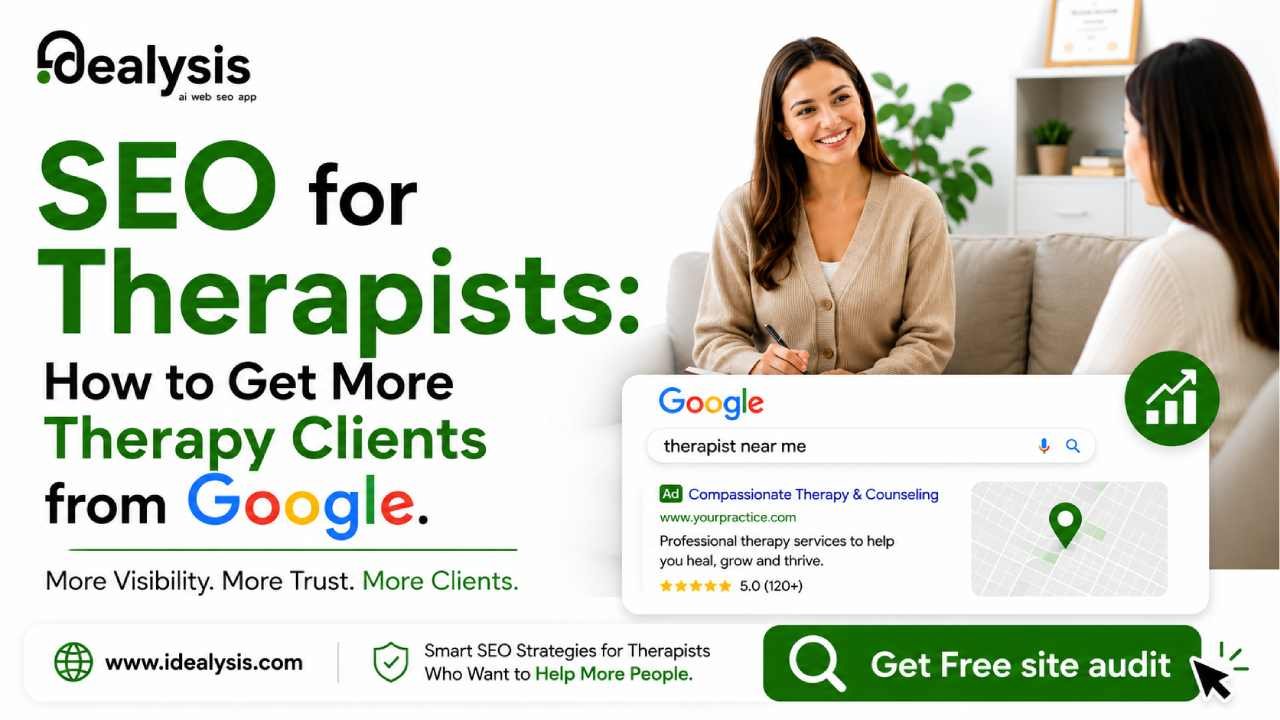
SEO for psychologists is the process of optimising your psychology practice to appear in Google search results and Google Maps when potential clients search for mental health help nearby. The foundation rests on three elements: a fully verified Google Business Profile, condition-specific service pages targeting local keywords, and structured website content that both Google and AI-powered answer engines can extract and trust.
You spent years earning your doctorate, completing supervised hours, and building clinical expertise. Your website, by contrast, may have taken a few hours to set up and has not been touched since. That imbalance is costing you clients.
SEO for psychologists sits at the intersection of clinical credibility and digital visibility. Someone typing ‘clinical psychologist near me’ or ‘child psychologist in Houston’ is making a high-stakes decision. They will read your credentials, assess your website’s professionalism, and look at your reviews — all before they ever contact you. If your practice does not appear in those first results, the clinical work that follows never gets a chance.
This blog explains exactly how SEO for psychologists works, why most psychology websites underperform on Google, and what a well-structured SEO approach looks like for practices of different specialisations. Work through it in order and you will understand precisely what needs fixing — and in what sequence.
Why SEO for Psychologists Is Different from Standard Local SEO
Psychology practices face a specific set of SEO challenges that do not apply to most local businesses. Understanding them changes how you prioritise your efforts.
SEO Challenge
Why It Applies to Psychologists
Practical Impact
Google’s YMYL policy
Psychology = mental health = ‘Your Money or Your Life’ content. Google applies stricter quality standards.
Thin or generic content ranks poorly; EEAT signals are disproportionately important.
High local competition
Most metro areas have dozens of licensed psychologists.
Generic city-level targeting is not enough; specialisation + location targeting is essential.
Trust barrier in search
Potential clients research carefully before clicking.
Website credibility signals (credentials, photos, reviews) convert more than design alone.
Multiple specialisations
Clinical, child, forensic, neuropsychology, counseling — each has distinct search queries.
One generic website cannot rank for all; separate service pages are required.
Telehealth expansion
Online psychology now operates across state lines.
State-specific landing pages for telehealth extend geographic reach significantly.
The YMYL distinction is the most consequential. Google applies its highest editorial standards to websites covering health, mental health, and medical advice. A psychology website with weak EEAT signals — no author credentials, no professional associations listed, no clear about page — will be systematically suppressed in favour of more authoritative sources. Building EEAT is not optional for a psychology practice. It is the prerequisite for everything else.
See how Idealysis builds SEO for healthcare and service businesses: SEO Services
EEAT for Psychologists: Why Credentials Must Appear on Your Website
EEAT stands for Experience, Expertise, Authoritativeness, and Trustworthiness. Google introduced these signals specifically to elevate professional, credentialed content over generic marketing copy in sensitive fields — and psychology sits squarely in that category.
Most psychology websites fail at EEAT not because the psychologist lacks credentials, but because those credentials are not expressed on the website in a way Google can read and weigh. Here is what Google’s quality raters look for:
Gap 1: Credentials buried or absent Your doctorate, licence number, supervised hours, and professional association memberships should appear on your About page, your author bio, and your homepage footer. Not one of these — all of them. A psychology website that lists only a first name and a phone number is an EEAT failure from Google’s perspective.
Gap 2: No author attribution on blog content Every blog post or educational article on your site must show an author byline with credentials. ‘Written by Dr Sarah Mitchell, PhD, Licensed Clinical Psychologist’ is the format. Anonymous articles on mental health topics are a red flag for Google’s quality raters and suppress your ranking across the site.
Gap 3: No professional association signals Membership in the American Psychological Association, British Psychological Society, or equivalent body provides an authoritativeness signal. Display these logos and links prominently. A link from the APA’s member directory to your website is also a high-authority backlink — pursue it actively.
Gap 4: No patient-facing trust indicators Potential clients look for: accepted insurance, HIPAA compliance statement, telehealth platform information, and whether you offer an initial consultation. These are conversion signals as much as trust signals. Their absence increases bounce rate — which indirectly suppresses rankings.
Keyword Strategy for Psychologists: How to Target Searches That Convert
Psychologist SEO keyword strategy follows a clear hierarchy: specialisation first, location second, intent third. Targeting ‘psychologist’ alone is too broad and too competitive for a private practice to rank for nationally. The searches that generate client enquiries are specific.
Keyword Type
Example
Competition
Who Searches This
Broad — avoid
‘psychologist’
Extremely High
Too generic to convert
City-level
‘psychologist in Houston’
High
Moderate intent; use as secondary
Specialisation + city
‘clinical psychologist Houston’
Medium
High intent — primary page target
Specialisation + neighbourhood
‘child psychologist River Oaks Houston’
Low
Very high intent — start here
Condition-based
‘OCD psychologist near me’
Low–Medium
Urgent searchers — very high conversion
Modality-specific
‘EMDR psychologist Austin’
Low
Research-stage, moderate intent
Long-tail educational
‘how does cognitive behavioural therapy work’
Very Low
Blog content — early funnel traffic
Telehealth/online
‘online psychologist Texas’
Medium
Expanding audience — state pages
Start with one primary page per specialisation, each targeting ‘[specialisation] psychologist [city]’. A clinical psychologist in Denver should build ‘clinical psychologist Denver’, ‘anxiety psychologist Denver’, and ‘trauma psychologist Denver’ before attempting any broader targeting. One well-optimised specific page will outrank ten generic ones every time. Idealysis builds full keyword strategies for local service businesses: Local SEO Services
Google Business Profile for Psychologists: The Map Pack Is Where Clients Click First
The Google Map Pack — the three business listings shown above organic results for local searches — captures the majority of clicks for ‘psychologist near me’ queries. Your Google Business Profile (GBP) is the sole lever for Map Pack ranking. An incomplete or unverified profile guarantees you are not in those three spots.
Complete GBP Optimisation in Six Steps
1. Claim and verify your listingWithout verification, you do not exist in the Map Pack. Visit business.google.com. Search your practice name. Claim an existing unclaimed listing or create a new one. Verify via postcard, phone, or video — whatever Google offers in your area. The verification step is the gatekeeper to everything that follows.
2. Set your primary category preciselyCategory is the single strongest relevance signal in the local algorithm. Select ‘Psychologist’ as your primary category. Add secondary categories matching your specialisations: ‘Child Psychologist’, ‘Mental Health Clinic’, ‘Clinical Psychologist’. The right primary category connects your profile to the right search queries. A generic ‘Health’ category is a significant ranking disadvantage.
3. Write a specialisation-rich business descriptionName your conditions, populations, and your city — in plain client-facing language. Example: ‘A licensed clinical psychologist in Denver specialising in anxiety disorders, OCD, and trauma. I work with adults and adolescents using evidence-based approaches including CBT and EMDR. Telehealth sessions available for Colorado residents.’ Under 750 characters. Written for the person reading, not keyword density targets.
4. List every service individuallyEach GBP service entry is a relevance signal for its own search query. Add one entry per condition and approach: anxiety therapy, OCD treatment, trauma therapy, EMDR, neuropsychological assessment, child psychology, couples psychology. Add a two-sentence description to each. This is how Google matches your profile to specific condition-based searches rather than only name-based ones.
5. Upload 10+ professional photosPhotos increase direction requests and call clicks measurably. Include: building exterior, reception area, consulting room (without identifiable client materials), and a professional headshot in a clinical setting. Avoid stock photography — it reads as inauthentic, especially for a trust-sensitive mental health practice. Practices with 10+ genuine photos consistently outperform those with 2–3 on GBP engagement metrics.
6. Post weekly and respond to every reviewActive profiles outrank dormant ones. Review responses signal trust. A GBP post takes 10 minutes. Write 80–150 words about a condition you treat, a treatment approach you use, or an availability update. Post every week. When reviews arrive, respond within 48 hours. Keep responses warm, professional, and HIPAA-conscious: never confirm someone is or was a patient. Idealysis provides full GBP management and local SEO for psychologists →
Psychology Website SEO: The Structural Requirements That Drive Rankings
A psychology website that performs in search has four non-negotiable structural elements. Most practice websites are missing two or three of them.
Element 1 — A Page Per Specialisation
Your homepage cannot rank for clinical psychology, child psychology, neuropsychology, and anxiety treatment simultaneously. Each specialisation requires its own dedicated URL. Each page must:
Include the specialisation + city keyword in the H1 and meta title.
Answer ‘who do you help and how?’ within the first 60 words.
Describe your specific approach and evidence base (CBT, ACT, DBT, EMDR, neuropsychological testing).
Include a 4–6 question FAQ section with direct answers, marked up with FAQPage schema.
End with a clear call to action: a booking link, contact form, or initial consultation offer.
Element 2 — A Credentialled About Page
Your About page is one of the highest-traffic pages on any psychology website. It is also where EEAT is built or lost. Include:
Full credentials: doctoral degree, institution, year of completion.
Licence information: licence number, state, and licensing body.
Professional memberships: APA, state psychological association, specialty boards.
Specialisation training: any post-doctoral training, certifications, or supervised specialty experience.
Practice philosophy: a short, genuine explanation of your approach — written for a client, not a colleague.
Element 3 — Technical Health
Check these now. Each one directly impacts rankings and conversions:
HTTPS: mandatory. A psychology website without an SSL certificate is a trust failure on two levels — user trust and Google trust.
Mobile load time: under 3 seconds. Use PageSpeed Insights to check. Unoptimised clinical headshots and office photos are the most common culprit.
Contact path on mobile: test your own form on an iPhone and an Android. If anything is awkward to tap, fill, or submit, you are losing enquiries at the final step.
No 404 errors: run a crawl via Google Search Console or Screaming Frog. A broken link to a service page is a wasted ranking opportunity.
Element 4 — Schema Markup
Schema is structured data that tells Google explicitly what type of business you are and what your content covers. For psychology practices:
LocalBusiness (MedicalBusiness subtype): your practice name, address, phone, hours, geo coordinates.
Person schema: your credentials, licence, and professional memberships.
FAQPage schema: marks your FAQ sections for Google to expand directly in search results — increasing click-through rate without needing a higher ranking position.
MedicalCondition schema: signals to Google which conditions your content covers.
Court referrals, legal context, professional boundary language
Counseling psychologist
‘counseling psychologist [city]’
‘Difference between counseling psychology and clinical psychology’
Life transitions, wellness focus, shorter-term work
Health psychologist
‘health psychologist [city]’
‘How does psychology help chronic illness management?’
Medical team integration, chronic disease, behaviour change
Online / telehealth
‘online psychologist [state]’
‘Is online psychological therapy as effective as in-person?’
State licencing, platform security, broader geographic reach
Do not try to rank for all specialisations at once. If your primary work is clinical psychology with a secondary interest in trauma, build the clinical psychology page first, get it ranking, then build the trauma page. Sequential depth beats simultaneous breadth every time.
AI SEO for Psychologists: Getting Cited in Google AI Overviews and Answer Engines
Google’s AI Overviews now appear above the standard organic results for many psychology-related queries. ‘What is the difference between a psychologist and a psychiatrist?’, ‘How long does CBT take?’, ‘How to find a child psychologist near me?’ — all of these increasingly return AI-generated summaries pulling from trusted, well-structured content.
To appear in these AI responses — and to be cited by ChatGPT, Gemini, and Perplexity when users ask about finding a psychologist — your pages need this structure:
Lead with a direct answer. The first 50–70 words of every page and article should answer the primary question clearly. Do not build to the point.
Use question-based H2 and H3 headings. ‘How Does CBT Help Anxiety?’ is more extractable by AI than ‘Our Approach.’
Keep answer paragraphs between 40 and 70 words. Concise, self-contained paragraphs are what AI systems pull from.
Include a FAQ section on every service page — 4–6 questions with direct answers. Mark up with FAQPage schema.
Include your name, credentials, city, and specialisation in your page content naturally. AI local results use these signals for geographic matching.
The psychology sector is under-optimised for AI search. Most practice websites were built in an era of traditional SEO and have not been updated for the answer-engine landscape. This gap is a genuine ranking and citation opportunity for psychologists who act now. Idealysis specialises in AI SEO and Answer Engine Optimisation for healthcare and local service businesses.
Content Marketing for Psychologists: Blog Posts That Build Authority Before First Contact
Psychology blog content serves a specific function in the client acquisition funnel: it attracts people researching their situation but not yet ready to book, and positions you as the expert they already trust when they finally are ready.
The most effective formats for psychologist blogs:
Condition explainers:‘What Is Generalised Anxiety Disorder and How Is It Diagnosed?’ — high educational intent, often searched by people considering professional help.
Treatment guides:‘How Does EMDR Work for Trauma Recovery?’ — establishes modality expertise for people researching specific approaches.
Comparison content:‘Psychologist vs Therapist vs Psychiatrist: What Is the Difference?’ — one of the highest-traffic psychology-adjacent queries, positions you as the authoritative source.
Decision-support content:‘When Should I See a Psychologist Instead of a GP for Mental Health?’ — meets people at the exact decision point most relevant to your practice.
Local resource guides:‘Mental Health Services in [Your City]: A Guide for Adults and Families’ — attracts local backlinks from community organisations and health pages.
Publish one article per month at minimum. Write 1,000–1,600 words. Answer the reader’s primary question in the first two paragraphs. End with a CTA pointing to the relevant service page. The compound effect — 12 indexed articles by month 12, each generating their own search traffic — is where content marketing earns its long-term investment.
Local Link Building for Psychologists: Building Authority Without Spam
Backlinks from relevant, authoritative websites remain one of Google’s most significant ranking inputs. For psychologists, priority is quality and relevance over volume.
APA and state psychological association member directories: most link directly to members’ practice websites. If yours does not, request it.
Hospital and medical centre resource pages: many community health pages maintain directories of independent practitioners. Contact patient services directly.
University and college counselling resource pages: psychology departments and student wellness centres often link to local licensed practitioners.
Employee Assistance Programme directories: EAP providers list contracted psychologists; each listing typically includes a practice website link.
Local mental health resource guides: city councils, nonprofits, and community health organisations publish resource lists. Email your practice URL once your site is ready.
The most efficient link-building tactic: publish a ‘Psychology and Mental Health Resources in [City]’ guide on your website. Email it to the five organisation types above in your city. Multiple organisations will link to it organically because it serves their audience. One well-placed resource guide typically generates 3–8 relevant backlinks within 90 days.
Reviews for Psychologists: Building a Credibility Signal That Compounds
Google uses review count, recency, and average rating as prominence signals in the local ranking algorithm. Simultaneously, potential clients use reviews as a primary trust signal before enquiring. Reviews work on both levels simultaneously.
A sustainable review strategy: after a client’s second or third session, mention briefly that a Google review helps other people find the practice. Add your review shortlink to your email footer. Respond to every review within 48 hours. Never confirm a therapeutic relationship in your response. Aim for 1–2 new reviews per month consistently — review velocity matters as much as total count.
A 90-Day SEO Roadmap for Psychologists
Month 1 — Establish the Foundation
Claim, verify, and fully optimise your Google Business Profile (all six steps above).
Audit your NAP across all directories: Google, Bing Places, Psychology Today, Healthgrades, Yelp. Fix inconsistencies.
Run PageSpeed Insights on your website. Fix the top three mobile speed issues.
Set up Google Search Console and submit your XML sitemap.
Add your full credentials, licence, and professional memberships to your About page.
Month 2 — Build the Content Architecture
Create one dedicated service page for each of your primary two specialisations.
Rewrite your homepage H1 and opening paragraph to include your specialisation, city, and target population.
Add FAQPage schema and a 4–6 question FAQ to each new service page.
Add author bylines with credentials to any existing blog content.
Begin weekly GBP posts (10 minutes each, once per week).
Month 3 — Build Local Authority
Submit your practice to the APA member directory and your state psychological association directory.
Publish your first blog post targeting a condition-education keyword.
Implement LocalBusiness and Person schema on your homepage and About page.
Begin your review acquisition strategy — add review link to your email footer.
Review Search Console data. Which queries are gaining impressions? Optimise those pages next.
Realistic Timeline and Cost for Psychology Practice SEO
Phase
Timeframe
What Changes
GBP improvements
Weeks 4–6
Profile views, direction requests, call clicks beginning to increase
Early keyword gains
Months 2–3
Long-tail condition pages begin indexing and gaining impressions
Map Pack ranking
Months 3–5
Primary city specialisation keywords entering top 5–10
Organic session growth
Months 4–6
Month-over-month organic traffic growing from service pages
Consistent enquiries
Months 6–9
Regular monthly enquiries from organic search and Map Pack
Compounding returns
Months 9–12+
Blog traffic adds to foundation; Map Pack consolidated; ROI clear
Investment Type
Typical Cost
What Is Included
DIY SEO
Time only (10–15 hrs/month)
GBP, content, citations — slower timeline without technical expertise
One-time technical audit
$600–$1,500
Prioritised fix list; practice implements independently
Monthly SEO (basic)
$400–$900/month
GBP management, citation audit, content strategy
Monthly SEO (full service)
$900–$2,000/month
Full strategy + implementation + content + reporting
Website build + SEO
$3,000–$7,000 one-time
New SEO-ready practice site; ongoing service separate
The ROI calculation is clear. A psychologist billing $150–$250 per session at 4–6 sessions per week per client earns $3,000–$7,500 per year from a single new regular client. SEO generating two new clients per month creates an annual revenue impact that far exceeds any professional SEO service investment.
Every psychology website that fails to generate enquiries from Google has the same problem: it was built to describe a practice, not to be found by clients searching for help. Those are two different briefs with two different outcomes.
SEO for psychologists is not mystical. It is a series of specific, ordered actions: fix your GBP, build your EEAT signals, create specialisation-specific pages with the right keyword targets, publish structured content consistently, and earn reviews at a steady cadence. Each action compounds on the last.
Psychologists who implement this framework find themselves in an unusual position: fully booked from organic search alone, with a waitlist, generating enquiries they did not pay for from people who found them because of a blog post written months earlier. That is the compounding nature of SEO — and it is available to any practice willing to build it methodically.
Is Your Psychology Practice Invisible on Google?
Idealysis audits and fixes the SEO gaps that keep psychology websites from generating consistent client enquiries. From EEAT optimisation and GBP management to condition-specific page strategy and AI search optimisation, we build the system that fills your practice — not just your traffic report. Get Your Free SEO Audit →
FAQs
What is SEO for psychologists?
SEO for psychologists is the process of making a psychology practice visible in Google search results and Google Maps when potential clients search for mental health services. It includes optimising the Google Business Profile, creating specialisation-specific service pages with local keywords, building citations, earning reviews, and publishing structured content for AI-powered answer engines.
How do psychologists get more clients from Google?
Psychologists get more clients from Google by fully optimising their Google Business Profile, creating dedicated pages for each specialisation targeting city-level keywords, maintaining consistent NAP across directories, building genuine client reviews, and publishing condition-education blog content that answers the questions potential clients are already searching for.
What is EEAT and why does it matter for psychology websites?
EEAT stands for Experience, Expertise, Authoritativeness, and Trustworthiness. Google applies these standards most strictly to health and mental health content. Psychology websites with clearly displayed credentials, professional association memberships, author bylines on articles, and transparent practice information rank significantly higher than those without these signals.
How long does SEO take for a psychology practice?
Google Business Profile improvements typically appear within 4–6 weeks. Condition-specific pages begin ranking within 2–4 months. Consistent monthly enquiries from organic search and the Map Pack typically arrive within 5–8 months of consistent SEO work. Results compound month over month after that initial period.
Should psychologists use Psychology Today or invest in SEO?
Both serve different roles. Psychology Today provides directory traffic but is a rented audience — you pay monthly and traffic stops if you cancel. Your own website ranking in Google is an asset you permanently own. Use Psychology Today as a supplement, and make your own website and GBP the primary long-term strategy.
What keywords should a clinical psychologist target for SEO?
Start with ‘clinical psychologist [your city]’ as your primary page target. Add condition-specific pages: ‘anxiety psychologist [city]’, ‘OCD psychologist [city]’, ‘trauma psychologist [city]’. For blog content, target educational queries like ‘how does CBT work’ and ‘signs you need a clinical psychologist’. Neighbourhood-level targeting works well in competitive metro areas.
Share This Blog
Get More Clients from Google
We help businesses rank higher and get more inquiries and appointments.
Over 10 years, 50+ client sites across the US, UK, and Australia. Himanshu spends two hours inside a client's Search Console before forming an opinion. That's just how he works. Every challenge he couldn't find a straight answer to online became a blog post on Idealysis. Real problems, real fixes — nothing recycled from someone else's guide. He covers SEO, AEO, GEO, and AIO. Because that's where search actually lives now.



 AI-Powered SEO
 Conversion-Focused Websites
 No Long-Term Contracts
 Transparent Reporting