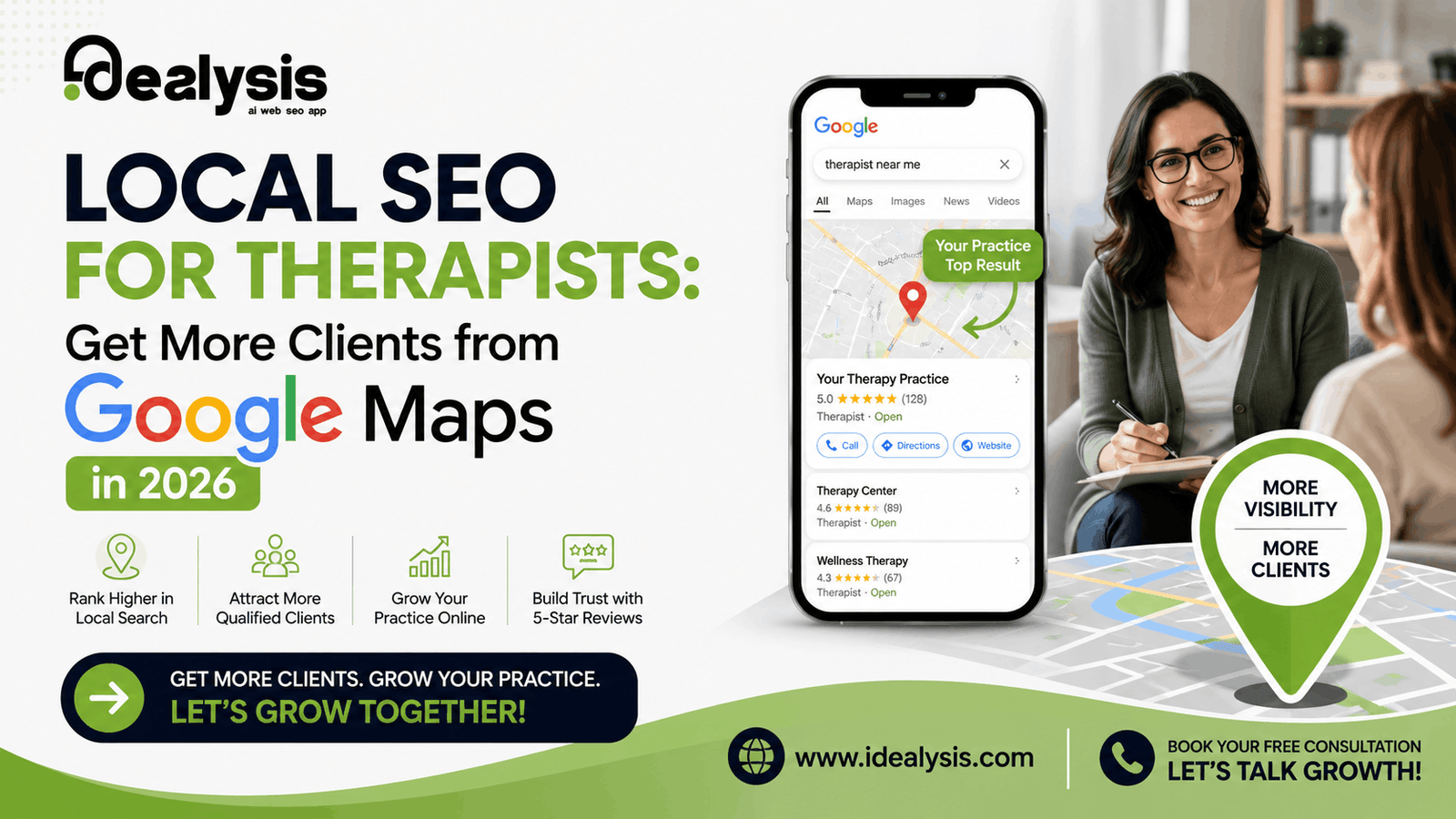
Local SEO for therapists means optimising your practice to appear in Google Maps and the local pack when people search for mental health help in your city. The three pillars are: a fully verified Google Business Profile, consistent NAP citations across directories, and location-specific pages on your website. Get these right and you rank without paying for ads.
Most therapy clients do not find their therapist through a referral anymore. They open Google, type ‘therapist near me’ or ‘anxiety therapist in [city]’, and choose from the first three results that appear on the map. If your practice is not in that map pack, you are invisible — regardless of how good your clinical work is.
Local SEO for therapists is the discipline of making your practice appear precisely where those searches happen. It is not the same as general website SEO. Local SEO is about proximity, relevance, and trust signals that are specific to your geographic area. The tactics are different, the timeline is different, and the ROI — for a service with recurring monthly sessions — is exceptional.
This blog covers the complete local SEO picture for private practice owners: from your Google Business Profile to citation auditing, review strategy, hyperlocal content, and local link building. Work through it in order and you will have the foundation of a practice that fills enquiries from Google month after month.
1. Why Local SEO Is the Highest-ROI Marketing Channel for Therapists
A therapist in Austin or Atlanta does not need national visibility. She needs to be found by the 40 or 400 people in her city searching for what she offers this week. Local SEO concentrates all your effort exactly there.
The economics are compelling. A therapy client typically books weekly or biweekly sessions. One new client from a Google search may generate $3,000–$8,000 in annual revenue. If local SEO brings in three new clients per month at zero cost-per-click, the return on a modest monthly SEO investment is significant.
Channel
Cost Per Lead
Retention Value
Google Maps / Local Pack
Near-zero once ranked
High — recurring sessions
Google Ads PPC
$15–$60 per click
Zero — stops with budget
Psychology Today listing
Monthly subscription fee
Medium — platform dependency
Social media ads
$20–$80 per conversion
Low — cold audience
Word-of-mouth referral
Zero
Very high — pre-qualified
The table shows what experienced practice owners already know: local organic search and referrals are the two channels worth building. SEO scales; referrals do not always.
See how Idealysis builds local visibility for service businesses: Local SEO Services
2. How Google Decides Who Appears in the Therapist Map Pack
Google’s local ranking algorithm has three documented factors. Understanding them changes how you prioritise your time.
Factor
What It Means
Your Lever
Relevance
Does your profile match the searcher’s query?
Category selection, GBP description, service keywords
Distance
How close is your practice to the searcher?
Accurate address; telehealth pages for broader reach
Prominence
How well-known and trusted is your business?
Reviews, citations, backlinks, GBP activity
Relevance and prominence are the two levers you control directly. Distance is fixed — but telehealth practice areas and suburb-specific landing pages let you expand your effective coverage without moving your office.
Most therapists under-invest in prominence. They claim their GBP, add basic details, and stop. Prominence requires ongoing activity: consistent reviews, weekly posts, citation management, and inbound links from local sources. It compounds over time.
3. Google Business Profile Optimisation: Your Most Important Local SEO Asset
Your Google Business Profile (GBP) is the control panel for your Map Pack ranking. An incomplete profile is a direct ranking penalty. An optimised profile, by contrast, is the fastest single action you can take to improve local visibility.
Step-by-Step GBP Optimisation for Therapists
1
Claim and verify your listing Go to business.google.com. If your practice already has an unclaimed listing, claim it. Verify via postcard or phone. Unverified profiles do not appear in the Map Pack.
2
Choose the right primary category Select the most specific option available: ‘Mental Health Clinic’, ‘Psychologist’, ‘Marriage Counselor’, or ‘Counselor’. Avoid generic categories like ‘Health’ — they dilute relevance signals.
3
Write a keyword-rich business description Include your city, your specialisations (anxiety, depression, trauma, couples), and who you help. Keep it under 750 characters. Write for the person searching, not for Google’s algorithm.
4
Add all services individually GBP lets you list each service separately with a description. Add one entry per therapy modality or condition: CBT, EMDR, couples therapy, adolescent therapy, grief counselling. Each one is a relevance signal.
5
Upload real, high-quality photos Minimum 10 photos: exterior of building, reception/waiting area, therapy room, and a professional headshot. Practices with 10+ photos receive significantly more direction requests than those with fewer.
6
Set accurate hours including telehealth If you offer evening or weekend availability, reflect it. Add telehealth as a service attribute. This appears directly in the Map Pack result and influences click-through rate.
7
Add your booking or enquiry link GBP allows a direct appointment booking link. If you use a scheduling tool like SimplePractice or Jane App, connect it here. Frictionless booking converts searchers faster.
8
Post weekly GBP posts are short updates (80–300 words) that keep your profile active. Write about a condition you treat, a new service, or a tip relevant to mental health. Google treats active profiles as more authoritative.
One example: a trauma-focused therapist in Portland added 14 photos, rewrote her business description with EMDR and her neighbourhood name, and began posting fortnightly. Within eight weeks her GBP calls rose from 6 to 23 per month — all without any paid ads or link building.
Idealysis offers full local SEO services including GBP optimisation, citation management, and ongoing local strategy.
4. NAP Consistency: The Citation Foundation Every Therapist Must Get Right
NAP stands for Name, Address, Phone number. Google cross-references your business details across dozens of directories to validate that your practice is real, stable, and where you say it is. Inconsistencies — even minor formatting differences — introduce ambiguity that suppresses your ranking.
The most common NAP mistakes therapists make:
Using ‘Dr Sarah Collins Therapy’ on the website but ‘Sarah Collins, LCSW’ on Psychology Today.
Having an old address on Yelp from a previous office location.
Listing a phone number with different formatting: (512) 555-0123 vs 512-555-0123 vs 5125550123.
Including ‘Suite 200’ in some listings but not others.
Choose one canonical version of your business name, address, and phone number. Apply it identically everywhere. Audit the following directories as a minimum: Google Business Profile, Bing Places, Apple Maps, Yelp, Psychology Today, Healthgrades, Zocdoc, Therapist Finder, WebMD, and your state psychology association directory.
⚠ Stale Listings Are Actively Hurting You If you moved offices in the last three years and did not update every directory, you have conflicting address signals that suppress your Map Pack ranking. This is more common than most therapists realise. Audit before building any new citations.
5. Reviews: How to Build a Review Strategy That Ranks and Converts
Reviews are a ranking signal and a conversion signal simultaneously. Google uses review count, recency, and rating as prominence inputs. Meanwhile, a potential client reading your profile decides within seconds whether to click based on those same reviews.
For therapists, the ethical challenge is real. You cannot solicit detailed reviews that breach confidentiality. What you can invite: comments about the process, the environment, the ease of booking, and the professional experience.
Building Reviews Ethically and Consistently
After a client’s first month, mention briefly that a Google review helps other people find the practice. Keep it conversational, not a formal request.
Add your Google review shortlink to your email footer and post-session follow-up messages.
If a client verbally expresses gratitude, it is appropriate to say: ‘If you ever felt comfortable sharing that online, it genuinely helps others.’
Respond to every review — positive and neutral. Write warm, professional responses. Never confirm someone is a client. Never reference their condition.
Review velocity matters as much as total count. Ten new reviews over six months signals more active engagement than ten reviews accumulated over three years. Aim for a steady cadence rather than a burst.
One practice in Minneapolis went from 4 reviews to 31 reviews over one months by adding a simple two-line review request to their intake completion email. Their Map Pack position moved from outside the top 10 to a consistent top-3 placement for ‘anxiety therapist Minneapolis’.
For a full review and citation strategy, see Idealysis SEO services for healthcare and local businesses.
6. Hyperlocal Content: City and Neighbourhood Pages That Rank
Your website content needs to do more than describe your services. For local SEO, it must signal to Google exactly where you operate and who you serve.
Location Pages That Actually Work
A location page for ‘anxiety therapist in Denver’ needs to do more than swap a city name into a template. Write genuinely useful content:
Address the local context: mental health access challenges, waitlist realities, or telehealth availability in that state.
Include the city name in your H1, meta title, first paragraph, and at least two subheadings.
Add a local FAQ: ‘Do you accept Colorado Medicaid?’, ‘How far is your office from downtown Denver?’
Embed your Google Map on the page.
Include a testimonial from a client in that area (with permission, anonymised).
Neighbourhood Pages for Competitive Cities
In large cities like New York, LA, or Chicago, ranking for ‘therapist in New York’ is extremely difficult. Ranking for ‘therapist in Brooklyn Heights’ or ‘couples therapist Upper West Side’ is far more achievable — and those searchers are closer to your office.
Create one page per neighbourhood you actively serve. Keep each page at least 600 words of genuinely distinct content. Do not spin the same template with different suburb names — Google has identified this pattern and penalises thin location pages.
Idealysis builds location-specific content strategies for local service businesses. See our work for examples.
7. Schema Markup for Therapists: Help Google Understand Your Practice
Schema markup is structured data in your site’s code that tells Google exactly what type of business you are, where you are, and what you offer. It does not directly boost rankings but it dramatically improves how your content appears in search results, including rich snippets, FAQs, and AI Overviews.
Essential Schema Types for a Therapy Practice
LocalBusiness (subtype: MedicalBusiness) — includes your practice name, address, phone, hours, and geo coordinates.
Physician or Person schema — your professional credentials, licences, and areas of specialisation.
FAQPage schema — marks up your FAQ sections so Google can expand them directly in search results.
Service schema — describes each therapy service with its service area and description.
AggregateRating schema — displays your star rating directly in organic search results (requires a structured review system).
You do not need to code this manually. On WordPress, Rank Math and Yoast SEO Premium both handle LocalBusiness and FAQPage schema via their UI. Test any schema implementation at search.google.com/test/rich-results before and after publishing.
Idealysis implements complete schema for healthcare and service clients as part of full SEO services. See our AI SEO approach for how we optimise for AI Overviews as well.
8. Local Link Building: The Authority Signals Most Therapists Miss
Backlinks from locally relevant websites are one of the strongest prominence signals in Google’s local algorithm. Most therapists ignore this entirely, or worse, pay for low-quality directory spam that does nothing.
Where to Build Local Links as a Therapist
State psychology association website — most list licensed members with a link to their site. If yours does not, request it.
Local hospital and medical centre resource pages — many community health pages link to independent practitioners in the area.
Employee Assistance Programme (EAP) directories — if you accept EAP referrals, each directory listing with a link counts.
Local HR and wellness blogs — offer to write a short guest post on stress, burnout, or workplace mental health.
Chamber of commerce member directory — a local business link with domain authority.
Community mental health resource guides — local nonprofits, universities, and city councils often publish resource lists you can be added to.
The most scalable tactic: write a ‘Mental Health Resources in [Your City]’ guide on your website. Email it to local HR teams, community organisations, and college student services departments. Many will share it or link to it. You gain backlinks and community goodwill simultaneously.
One Chicago therapist published a ‘Mental Health Resources in Chicago’ post with a directory of crisis lines, community services, and support groups. Within four months, three local nonprofits and one city health department page had linked to it organically. Her domain authority grew by 6 points.
9. Technical Local SEO: What Your Website Must Get Right
Local SEO does not live only on your GBP. Your website sends co-ranking signals that Google weighs alongside your profile. These technical elements are non-negotiable.
Technical Checklist for Therapy Websites
Mobile-first design: Over 60% of ‘therapist near me’ searches happen on mobile. If your contact form does not work cleanly on a phone screen, you are losing enquiries at the last moment.
Page speed: Your homepage should load in under 2.5 seconds on mobile. Use PageSpeed Insights (pagespeed.web.dev) to check. The most common culprit for therapy sites is unoptimised headshot and office photos.
Embedded Google Map: Include an embedded map on your Contact page and any location-specific pages. It is a local relevance signal.
Local phone number visible in site header: A local area code reinforces your geographic relevance. An 800 number works for telehealth but weakens local signals.
Location in title tags and meta descriptions: Every location page needs the city in its meta title. ‘Anxiety Therapy in Denver | Sarah Collins, LCSW’ is correct. ‘Anxiety Therapy | Sarah Collins’ is a missed opportunity.
Internal linking between location and service pages: Your Denver page should link to your anxiety therapy page and vice versa. This helps Google understand the relationship between your location and your services.
Idealysis offers a free SEO audit that covers all technical, local, and content issues for your therapy website.
10. Telehealth Local SEO: Expanding Your Geographic Reach
If you offer online therapy and hold licences in multiple states, your local SEO strategy needs separate state-specific pages. This is one of the most under-utilised opportunities in therapy practice marketing.
A therapist licenced in California, Nevada, and Oregon who offers telehealth can rank for:
‘Online therapist in Nevada’
‘Virtual anxiety therapy for Oregon residents’
‘Telehealth therapist accepting California Medi-Cal’
Each of these requires a dedicated page — not identical templates with swapped state names, but genuinely useful pages that address insurance, licencing, and platform specifics for that state. Thirty minutes of original writing per page is the investment. The return is ranking in entirely new geographic markets.
In your GBP, use the ‘service area’ feature to list the cities you serve via telehealth. This extends your Map Pack relevance beyond your physical address.
11. How to Track and Measure Your Local SEO Results
SEO work without measurement is guesswork. These five metrics tell you whether your local SEO is actually working for your practice.
Metric
Where to Check
Target Benchmark
GBP calls per month
GBP Insights → Calls
Increase month-over-month
Direction requests
GBP Insights → Directions
Trend upward over 90 days
Map Pack position
BrightLocal or Whitespark Rank Tracker
Top 3 for primary keywords
Organic sessions
Google Analytics 4 → Traffic → Organic
Month-over-month growth
Contact form submissions
GA4 Events or form plugin reports
Conversion rate > 12%
Set a 20-minute monthly review. Pull GBP Insights, check Search Console for keyword position changes, and look at organic session trends. You do not need an agency dashboard to do this — a simple spreadsheet tracking these five numbers each month is more than sufficient.
12. Your 90-Day Local SEO Plan for a Therapy Practice
Here is the sequenced action plan. Follow it in order — each phase builds on the last.
Month 1 — Fix the Foundation
Claim, verify, and fully optimise your Google Business Profile (all 8 steps from Section 3).
Audit your NAP across 10+ directories. Fix every inconsistency.
Add LocalBusiness schema to your website homepage and contact page.
Set up Google Search Console and connect Google Analytics 4.
Month 2 — Build the Content
Create or rewrite location pages for your top 2–3 city/neighbourhood targets.
Add FAQPage schema and FAQ sections to every service page.
Write one blog post targeting a condition-education keyword (‘how does CBT help anxiety’).
Begin your weekly GBP post cadence.
Month 3 — Build Local Authority
Request listing on state psychology association site and 3 local health directories.
Publish your ‘Mental Health Resources in [City]’ guide and email it to 5 local organisations.
Begin the review acquisition strategy — add review link to email footer and post-session messages.
Review Search Console data. Identify which queries are gaining impressions and optimise those pages further.
Final Words
There is no shortcut here. Local SEO is a system, not a one-off fix. The practices that consistently dominate the Map Pack in their city are the ones that treat their online presence as an ongoing asset — not a task to complete and forget.
The good news: most of your competitors have done the bare minimum. They claimed their GBP, left the description vague, collected a handful of reviews three years ago, and stopped. The bar is genuinely not that high in most therapy markets outside of major metros. A therapist willing to spend two to three focused hours per month on local SEO will outrank most of her competition within a year.
Start with your Google Business Profile today. Fix your NAP citations this week. Build one genuine location page this month. Each action compounds. Twelve months from now, your enquiry list could be driven primarily by organic search — no paid ads, no directory subscriptions, no referral dependence.
Your clients are searching. The only question is whether they find you or your
Ready to Rank on Google Maps?
Idealysis helps therapists and healthcare professionals build local SEO systems that generate consistent, qualified enquiries. From GBP optimisation to full local content strategy, we handle the technical and strategic work so you can focus on clients. Get Your Free SEO Audit →
FAQs
What is local SEO for therapists?
Local SEO for therapists is the process of optimising your practice to rank in Google Maps and local search results when people search for mental health services in your area. It covers your Google Business Profile, website location pages, directory citations, reviews, and local backlinks.
How do therapists rank higher on Google Maps?
Therapists rank higher on Google Maps by fully optimising their Google Business Profile, earning consistent reviews, maintaining accurate NAP citations across directories, and building local backlinks from health associations and community organisations. Weekly GBP posts and location-specific website pages also strengthen Map Pack rankings.
How long does local SEO take to work for a therapy practice?
Most therapists see meaningful local ranking improvements within 60–90 days of consistent optimisation. Google Business Profile changes often show results in 4–6 weeks. Full city-level Map Pack ranking typically takes 3–6 months depending on competition.
Should therapists use Psychology Today or Google for local SEO?
Both serve different purposes. Psychology Today is a rented audience — traffic you do not own. Google organic and Maps rankings are assets you build permanently. Prioritise Google SEO as your foundation and use Psychology Today as a supplementary source of referrals.
What is the most important local SEO factor for therapists?
An optimised, verified Google Business Profile is the single most impactful local SEO action for therapists. Combined with consistent NAP citations and a steady flow of genuine reviews, it drives the majority of new client enquiries from Google for most private practices.
Do therapists need a website for local SEO?
Yes. A website is a required co-ranking signal for local SEO. Your Google Business Profile links to it, and Google uses your site’s content to validate your services, location, and expertise. A practice without a website has a significantly lower ceiling for Map Pack rankings.
Share This Blog
Get More Clients from Google
We help businesses rank higher and get more inquiries and appointments.
Over 10 years, 50+ client sites across the US, UK, and Australia. Himanshu spends two hours inside a client's Search Console before forming an opinion. That's just how he works. Every challenge he couldn't find a straight answer to online became a blog post on Idealysis. Real problems, real fixes — nothing recycled from someone else's guide. He covers SEO, AEO, GEO, and AIO. Because that's where search actually lives now.



 AI-Powered SEO
 Conversion-Focused Websites
 No Long-Term Contracts
 Transparent Reporting